Profile: Sarah Stilwell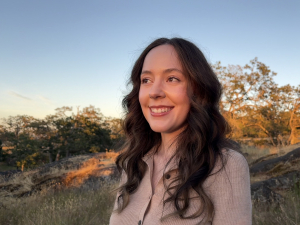
Sarah Stilwell still remembers sitting on a bench outside the Broken Promises exhibition at the Royal BC Museum, listening to visitors discuss what they had just seen. Some left deeply affected by the history of Japanese Canadian uprooting and dispossession. Others appeared to miss the exhibition’s central message entirely.
“I remember just sitting there being like, I don’t understand,” she recalls.
What puzzled her was not the exhibition itself, but why some visitors still failed to grasp the historical violence and racism it was attempting to communicate. The experience stayed with her and would later shape many of the questions that now sit at the centre of both her doctoral research and her work with Past Wrongs, Future Choices (PWFC).
A PhD candidate in Political Science at the University of Victoria and a researcher with PWFC since 2023, Stilwell studies the politics of memory, particularly the role museums and heritage institutions play in addressing histories of injustice. Her research asks how museums, exhibitions, and public history shape the ways societies understand accountability, democracy, and historical harm in the present.
“I’m specifically interested in new approaches Canadian museums have taken over the last decade to recognize legacies of injustice, and on the other hand, thinking about this at the level of ‘transnational memory’. For a while now, our global memory culture has been very connected with human rights, regret and collective remorse—a real belief that we can learn from the past, and retain important lessons from past generations. This actually became important to political legitimacy. But now, this human rights-centred idea of memory is increasingly being seen as in a moment of danger. We’re seeing a rise in ‘resistant remembrance’ (a term used by Levi and Rothberg), ways of subduing or trivializing regretful or remorseful stances toward traumas and injustices of the past. Over the last few years with PWFC, I’ve met quite a few curators and museum professionals, and other scholars and students, who feel this problem and its urgency in their work. I’m trying to do what I can to understand it.”
Interest in those questions began before her involvement with PWFC. During her master’s research, she became increasingly interested in how museums across Canada were rethinking public storytelling and historical accountability. When her PhD supervisor, political scientist Matt James, introduced her to the project and she began some work as a research assistant, the connection felt natural. The project’s focus on memory, human rights, and public engagement closely aligned with the direction her own research was beginning to take.
Looking back, she describes the first years of involvement as a period of listening and relationship-building. Much of the work involved understanding the broader historical and transnational contexts surrounding Nikkei uprooting and dispossession, while learning from people working across different disciplines and institutions. This included interviewing scholars, artists, curators, community members, and others connected with the project.
As the project matured, ideas gradually became tangible public initiatives. Conversations evolved into exhibitions, grant applications, museum partnerships, and international collaborations. What had once existed largely in planning meetings was becoming visible in public-facing work.
Among the many experiences she has had through PWFC, the project’s museum summit held at the Canadian Museum for Human Rights in Winnipeg remains especially memorable. Working closely with Jordan Stanger-Ross and other collaborators, she helped develop the grant application, coordinate planning, and facilitate conversations among museum professionals, scholars, and community members from Canada, the United States, Brazil, Australia, and Japan.
Before the summit, she worried about how to help create collaborative dialogue and conversations that could bring together so many participants with different institutional, disciplinary, and national perspectives. To encourage conversation, the organizing team explored the idea of “curatorial dreams,” a nod to Curatorial Dreams by Shelley Ruth Butler and Erica Lehrer, inviting participants to imagine what a globally integrated exhibition on Nikkei uprooting might look like if there were no financial or institutional constraints.
“If you could just dream up what this globally integrated exhibition would look like,” she recalls asking participants, “what would you dream up?”
The response exceeded expectations. Conversations quickly moved beyond historical content and into discussions of emotion, atmosphere, dance, embodiment, and sensory experience. Participants reflected on what an exhibition should feel, smell, or sound like, opening new possibilities for thinking about public history and memory across national boundaries.
That experience reinforced something she values deeply in both research and collaboration: listening.
“We’re good listeners,” she says, calling back to a conversation the two of us had in 2024, “and I think when we can listen well and learn from it, we can be good problem-solvers in research and on collaborative projects.”
Rather than approaching histories of injustice only through archives or institutional narratives, she increasingly emphasizes learning directly from communities, individuals, and experiences of curators, museum professionals and artists.
PWFC has also significantly influenced the direction of her doctoral research. Initially focused on Canadian museum discourse and debates surrounding institutional change, the project gradually expanded toward questions of transnational memory politics and community experience, an angle she was able to further develop as a fellow at the Centre for Global Studies this past year. Instead of concentrating primarily on critics of museum reform, she became more interested in how affected communities themselves feel about the importance of museum exhibitions and public storytelling, and wider contexts of memory and human rights.
At the same time, her academic perspective has influenced how she contributes to PWFC. Although she does not identify as a historian or curator, she often approaches the partnership from a broader perspective, connecting exhibitions, institutions, partnerships, and larger political questions surrounding memory and democracy.
This year, she received the 2025-26 Faculty of Social Sciences Graduate Excellence Award for Community-Engaged Research and Knowledge Mobilization at the University of Victoria. The award recognized collaborative work with museums and community partners, including projects connected to PWFC and internationally collaborative exhibitions.
The recognition carried particular significance because it affirmed the kind of work she hopes to continue pursuing.
“It felt so significant because what I really care about is knowledge mobilization,” she explains.
For her, knowledge mobilization describes the process through which scholarship, museums, communities, and public audiences learn from one another and create meaningful public impact together. Importantly, it’s about dialogue between different scholarly and professional areas, and what we can learn transnationally from other places and experiences. Having previously worked in communications, advocacy, and partnership-based environments prior to being an academic, she has long believed that some of the most meaningful outcomes emerge through collaboration.
Today, she is involved in two major exhibition initiatives connected to PWFC. The first is DIS, opening in September 2026 at the Nikkei National Museum and the Legacy Art Gallery, featuring contemporary artists engaging with histories of Japanese Canadian uprooting and dispossession. The second is supporting a globally integrated exhibition project underway that will bring different national contexts of Nikkei experiences together within a transnational framework.
Both projects arrive at a particularly significant moment. She views initiatives such as PWFC as part of a broader effort to preserve space for difficult historical conversations and democratic reflection.
Asked what she hopes audiences—particularly younger generations—take away from PWFC exhibitions, her answer returns to empathy, care, and learning from history to retain its lessons for human rights today.
“I think really just promoting a culture of care,” she says, “and looking at the past pretty critically and taking seriously that we don’t want these constitutional violations to happen again.”
Reflecting on the past several years, she describes the project as both intellectually transformative and unexpectedly serendipitous. What began with a visit to Broken Promises eventually became a deeply collaborative international research partnership stretching across museums, countries, disciplines, and communities.
“It still blows my mind,” she says, “especially that I now get to work quite closely with many of the people who made Broken Promises happen.”
For someone whose research examines how societies remember injustice, the journey has become more than an academic project. It has become a lived example of how collaboration, public history, and community engagement can shape new ways of understanding the past—and imagining the future.
The article was written by Ciel Dong from an interview with Sarah Stilwell.

 Instagram