Profile: Djuna Nagasaki
Gathering as Methodology: Space, Food, and Future among Younger Nikkei Communities
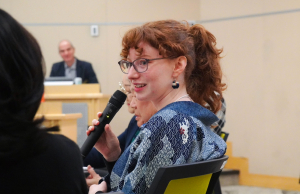
Last year, Djuna Nagasaki received the 2024–25 W. Kaye Lamb Award from the British Columbia Historical Federation for her honours research project, “Am I Japanese? Am I Nikkei? An Exploration of the Identities of Yonsei and Gosei Japanese Canadians.”
For Djuna, however, the project began long before university.
Growing up in Victoria, BC, on the traditional lands of the Songhees, Esquimalt, and Lekwungen-speaking peoples, she often found herself navigating questions about her Japanese surname, her family history, and a heritage she did not always know how to explain. As a child, she remembers feeling the constant presence of her name and wondering why parts of her family’s cultural identity felt distant or fragmented.
Those questions became more personal during a kindergarten heritage project. While other students brought photographs or flags, Djuna’s grandfather brought out something different: the family’s redress documents. “That became our family heirloom,” Djuna says, reflecting on how those papers became one of the few surviving records of what her family endured during internment. Through those documents, she first learned that her family had been uprooted and incarcerated during the Second World War — an experience that became both a personal connection to her family’s past and the beginning of a much larger search for understanding.
Djuna’s family history on the West Coast stretches back to the early twentieth century, when relatives immigrated from Kagoshima and settled in Vancouver’s Powell Street neighbourhood. Like many Japanese Canadian families, they built their lives through difficult labour, shared homes, and community ties. After decades of work, the family finally purchased a home of their own. “They moved into this home on December 6, 1941,” Djuna recalls. “And the next day, Japan attacked Pearl Harbor.”
Soon after, the house was confiscated. Her great-grandfather, Nobuo Nagasaki, protested the forced removal of Japanese Canadians from the coast and was arrested and sent to Angler prisoner-of-war camp, while other family members were dispersed to Greenwood and labour camps across the country.
Yet when Djuna speaks about her family history, she often returns not only to loss, but also to the warmth and resilience carried by those who came before her. Remembering her great-great-grandmother Kome, affectionately known in the family as “Grommie,” she describes a woman who continued to create joy and community in Greenwood despite incarceration — making furniture from discarded boxes, gathering with friends, and finding moments of lightness within extremely difficult circumstances. “There was a lot of laughter, a lot of jokes, and a lot of joy,” Djuna says.
At the same time, she also grew up feeling the effects of silence. Although aspects of culture remained within the home — family meals, stories, traditions, and her grandfather’s carefully designed Japanese-style house — there were still absences that shaped how younger generations understood themselves. Reflecting on those early feelings of disconnection, Djuna recalls asking her family as a child, “Why are we not Japanese anymore?”
Over time, she became what she describes as “the family historian,” interviewing relatives, collecting stories, and trying to understand how histories of internment and displacement continued to affect younger generations long after the camps themselves disappeared.
Now pursuing graduate studies in anthropology at the University of Toronto, Djuna describes anthropology as a field that allowed her to explore not only history, but also “the broader question of what it means to be human.” Rather than focusing solely on archival records or official narratives, she became increasingly interested in how memory, silence, identity, and belonging continue to shape lived experiences within Japanese Canadian communities today.
Her award-winning honours research focused on fourth- and fifth-generation Nikkei — Yonsei and Gosei Japanese Canadians — and the ways younger generations navigate identity, assimilation, disconnection, and community. Through interviews and gatherings, she found that many participants shared similar feelings of uncertainty around belonging, despite having very different family backgrounds and relationships to Japanese culture.
Food became one of the central ways she approached these questions. While language and other forms of cultural knowledge had often been disrupted through generations of silence and assimilation, food remained one of the strongest forms of continuity within her family. As Djuna describes it, her Japanese Canadian identity was “my grandpa’s kitchen.”
Her research eventually evolved into a short film titled In Our Grandparents’ Kitchens, where participants gathered to make gyoza, share stories, and reflect together. Rather than simply writing about community and disconnection, Djuna wanted to actively create spaces where younger Nikkei people could gather, speak openly, and recognize shared experiences in one another. Through those gatherings, participants began realizing that many of the feelings they carried — uncertainty, distance, imposter syndrome, or disconnection from community — were not isolated experiences. For Djuna, this process of gathering became both a form of research and a form of healing.
This idea of gathering continues to shape her work today.
Alongside her research, Djuna has contributed to projects connected to Japanese Canadian history and memory, including archival and museum initiatives related to Mayne Island. She often describes these projects not simply as preservation work, but as opportunities for reconnection, where oral histories and lived experiences become just as important as physical artifacts. “With a museum exhibit,” she explains, “the stories become the artifacts.”
Djuna also credits Past Wrongs, Future Choices with influencing how she approaches archives, memory, and artistic practice. Through PWFC exhibitions and installations, she encountered artists exploring Japanese Canadian histories not only through documentation, but through care, gathering, and repair.
Today, much of her work centres on creating spaces where younger Nikkei people can gather without feeling the need to justify or “prove” their identities. This desire eventually led her to help organize spaces for younger generations focused on connection, conversation, and shared experience across different Japanese Canadian and Nikkei backgrounds. As she explains, “I don’t want it to be a space where you have to prove your Japaneseness. I want it to be a space where you can simply celebrate it.”
For Djuna, this work remains deeply connected to the generations who came before her — to the family members who endured incarceration, dispersal, silence, and loss, yet continued to rebuild community afterward.
Reflecting on her childhood, Djuna remembers often feeling isolated within her family’s experience of internment and displacement. “When I was younger, I felt very lonely in my family’s experience,” she says. Through research, storytelling, and community-building, she now hopes younger Nikkei generations might feel something different: that they are not alone, and that there is still space to gather, reconnect, and imagine futures together.
This article was written by Ciel Dong from a November 2025 interview with Djuna Nagasaki.

 Instagram