Profile: Midori Ogasawara
From Investigative Journalism to Transforming Justice: Surveillance, Incarceration, and the Power of Data Collection
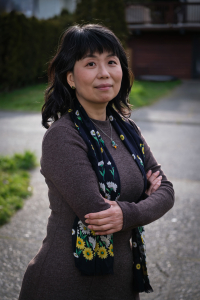
As a Scholar-in-Residence with Past Wrongs, Future Choices (PWFC), Dr. Midori Ogasawara brings a distinctive perspective to the study of Japanese Canadian mass incarceration. Rather than viewing the history solely as a wartime event, her work examines the systems of surveillance, data collection, intelligence gathering, and state power that made incarceration possible long before Pearl Harbor. Drawing on decades of experience as both an investigative journalist and a scholar of surveillance studies, Ogasawara’s research connects Nikkei histories in Canada to broader histories of colonialism, empire, racism, and technology across the Pacific.
For Dr. Midori Ogasawara, an Assistant Professor of Sociology at the University of Victoria, the study of state power, racializing surveillance, and social justice is not merely an academic pursuit—it is a lifelong mission forged in the newsrooms of Japan and refined through decades of work in Canada on surveillance activities by state-corporate power in the past and present.
Long before she began her academic work in surveillance studies, Ogasawara was an investigative journalist for The Asahi Shimbun, one of Japan’s most influential national newspapers. Born and raised in Yokohama, a major port city in Japan, she initially studied law at Waseda University, focusing on criminal law, family law, constitutional law, and systems of identification such as the Japanese koseki family registry system. At the same time, an exchange program in Oregon introduced her to feminist sociology and women’s studies, perspectives that would later shape both her journalism and academic work.
As a journalist, Ogasawara became deeply engaged with stories connected to wartime violence and state accountability, particularly the issue of so-called “comfort women” — women and girls subjected to sexual slavery under the Japanese imperial military system. Interviewing survivors in Korea and covering the International Women’s War Tribunal in Tokyo in 2000, which held the Japanese emperor and the high rank military officials accountable for the comfort women system, profoundly changed how she understood the history of colonialism that divides women not only during the wartime but also in the postwar.
At the same time, she also reported extensively on Okinawa and the impacts of U.S. military bases on local communities, especially violence against women. Reporting from Okinawa pushed her to question dominant narratives about militarism and “security.” Speaking with women living alongside military bases, she repeatedly encountered violence that contradicted official claims of protection and safety. “If the military is there to protect people,” she asks, “then why do the US soldiers sexually abuse women in Okinawa so often?”
Ogasawara describes this period as one in which direct encounters with survivors profoundly transformed her understanding of human rights and state violence. Listening to people who had experienced war crimes, occupation, and military violence firsthand made it increasingly difficult, she says, to separate journalism from ethical responsibility.
A major turning point came after 9/11, when public opposition in Japan to the American wars in Afghanistan and Iraq conflicted sharply with the editorial direction of the newspaper where she worked. Ogasawara recalls feeling increasingly troubled by the normalization of war and by institutional pressures within journalism itself. Eventually, after receiving a Fulbright Journalism Fellowship to study at Stanford University, she left the media and began reconsidering both her career and the larger systems she had spent years reporting on.
It was during this period in California that she began focusing more directly on surveillance and identification systems. Looking back, she traces this interest partly to debates in Japan during the late 1990s surrounding the digitization and centralization of the national identification system. At the time, older generations who had lived through wartime mobilization warned that centralized data system could become a tool of conscription (postwar Japan abolished the compulsory draft system). Ogasawara became increasingly interested in what happens when governments digitally collect, store, and use personal data — and how those systems reshape relationships between people and the state.
While researching these questions, she encountered the work of David Lyon, a leading sociologist in surveillance studies, at Queen’s University in Canada. What began as an email exchange about Japan’s centralization of personal data eventually led her to pursue graduate studies under his supervision. She moved to Canada in 2005, completed her master’s degree at Queen’s University, later returned to Japan for five years with her family, and eventually came back to Canada in 2013 to pursue her PhD.
Although Ogasawara had long known about the history of Japanese Canadian and Japanese American incarceration during the Second World War, she says she did not begin engaging deeply with these histories until moving to Victoria and joining the University of Victoria in 2021. Through colleagues, community members, and projects such as PWFC and the Landscapes of Injustice project, she began learning more about the broader structures surrounding Japanese Canadian dispossession and incarceration.
Today, her research examines these histories through the lens of surveillance studies. As a scholar-in-residence with PWFC, Ogasawara’s work explores what she describes as the “racializing surveillance” of Nikkei communities — the processes through which data collection, policing, intelligence gathering, and technologies of identification made mass uprooting and incarceration possible long before Pearl Harbor.
Drawing on the concept coined by scholar Simone Browne, Ogasawara emphasizes that “surveillance is never neutral.” Rather than simply monitoring populations, surveillance systems play an active role in producing racial categories and social hierarchies. In the case of Japanese Canadians, she suggests that the collection of information by the RCMP and other state agencies before the war helped construct Nikkei communities as populations to be monitored, controlled, and ultimately uprooted.
For Ogasawara, understanding these histories also requires placing them within broader transnational and colonial contexts. Her work connects Japanese Canadian incarceration to longer histories of anti-Asian racism, empire, policing, and surveillance across Canada, the United States, Australia, and Japanese colonialism in Asia. She is particularly interested in how surveillance practices targeting racialized communities continue to shape contemporary forms of governance and security discourse today.
Ogasawara notes that many students initially understand Japanese Canadian incarceration as a wartime exception or emergency measure. But for her, these events emerged from much longer structures of anti-Asian racism, surveillance, and empire. “It’s not solely because of war,” she explains. Understanding the historical preparation behind incarceration — the data collection, intelligence activities, and racial profiling that preceded it — is essential to understand how liberal democracies justify violence against racialized communities.
Her involvement with PWFC has also shaped how she thinks about collaboration and public history. She describes the project as an important space where scholars, artists, descendants, survivors, and community organizers can think together across disciplines and generations. Through conversations with colleagues and community members, she has been able to access archival materials, intelligence records, and transnational research networks that continue informing her work on surveillance and incarceration histories.
Alongside her own research, Ogasawara also collaborates closely with her partner, artist and photographer Ken Mizokoshi, whose work documents the memories and belongings of atomic bomb survivors from Hiroshima and Nagasaki. Together, they convened the Hiroshima and Nagasaki Poster Exhibition to commemorate the 80th anniversary of the atomic bombings in the Greater Victoria Public Library in 2025, exploring the ongoing human impacts of nuclear violence and war memory. Reflecting on these projects, Ogasawara emphasizes the importance of passing survivor testimonies to younger generations, especially as fewer direct witnesses remain alive today.
“We are kind of the testimony of the testimony,” she explains, describing how later generations inherit the responsibility of carrying these stories from the atrocities forward, not to repeat the same mistakes.
For Ogasawara, whether studying surveillance technologies, Japanese Canadian incarceration, or the memories of atomic bomb survivors, the central question remains deeply connected: how societies remember violence, how states justify it, and how communities continue resisting erasure.
Through her work, she hopes historical research can help people recognize that systems of surveil-lance and exclusion are never accidental or neutral. Instead, they are built over time — through pol-icies, technologies, institutions, and ways of seeing certain communities as threats. In other words, every policy and means of data collection and surveillance should be carefully examined not to as-sist future state violence towards any communities and individuals. Understanding those histories, she believes, is essential not only for understanding the past, but also for imagining more just and peaceful futures.
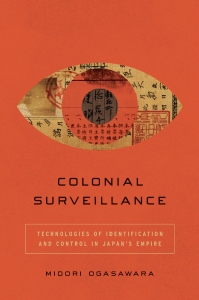
Ogasawara’s latest book based on her PhD research, Colonial Surveillance: Technologies of Identification and Control in Japan’s Empire, was published by Stanford University in 2026.
This article was written by Ciel Dong from a November 2025 interview with Midori Ogasawara

 Instagram