Where Histories Touch: DIS – displaced, dispersed, dispossessed and Contrapuntalism
Alisa Zheng
Alisa Zheng, MA is a Young Canada Works Building Careers in Heritage Intern at the University of Victoria Legacy Art Gallery.
Every morning, the blinds of the University of Victoria Legacy Art Gallery are reeled up, slowly unveiling the beams of morning light. As the light gently floods into the mezzanine, it brings a soft warmth to the otherwise chilly morning air. The tinkling gleam gradually falls onto Justin Seiji Waddell’s the earth is always shifting, the light is always changing, the sea does not cease to grind down rock, sitting directly across from the windows, awaiting its daily dose of morning glow. The light catches on the green sake glass wrapped in tomato-red wire, producing shards of reflection that bounce across the fragment of a memorial tree, standing tall for a new morning.
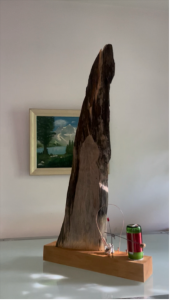
Courtesy of the artist, Justin Seiji Waddell. the earth is always shifting, the light is always changing, the sea does not cease to grind down rock, 2020-2026.
At the same time, Rachel Kiyo Iwaasa’s 灰汁 Aku, made in collaboration with artist SD Holman, is temporarily shrouded in the face of the bright light. Installed opposite to Waddell, the conceptual portrait of Iwaasa’s Aunt Chiyo is submerged into shadow; its cotton paper appears to merge with the washi paper placed atop it. A letter written by Iwaasa’s father regarding the death of his friend Nelson Small Legs Jr. sinks into the gloom of the antique lye crate it sits in. 灰汁 Aku awaits the afternoon light that will eventually illuminate the strawberry-red wall on which it is mounted, bringing it into the same brightness as a wire on a sake bottle.
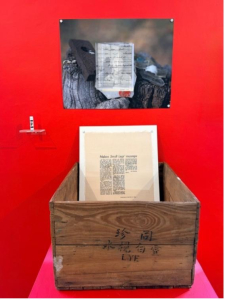
Rachel Kiyo Iwaasa with collaborating artist SD Holman, 灰汁 / Aku, 2026. Photo by Alisa Zheng.
Waddell and Iwaasa’s artworks are part of DIS – displaced, dispersed, dispossessed, a pair of concurrent group exhibitions at the Legacy Art Gallery and the Nikkei National Museum and Cultural Centre. Curated by Sherri Shinobu Kajiwara, Director/Curator at the Nikkei National Museum, with support from her Past Wrongs Future Choices curatorial team, DIS brings together 15 contemporary artists to explore the lasting influences of the Second World War on Nikkei communities globally.
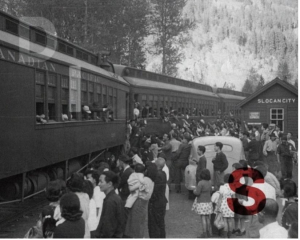
‘Repatriation’ to Japan, Slocan, British Columbia, c. 1946. Courtesy of the Nikkei National Museum & Cultural Centre, Odamura Family Collection (1996.178.1.33.a-b).
The exhibition is centred around the prefix “dis,” which Kajiwara explains emerged during the curatorial process when reflecting on language and its role in shaping memories of Japanese Canadian dispossession during the 1940s.[1] “Dis” as in “dispossession, displacement, dispersal, disenfranchisement, distortion, disregard, and dislocation” directly encompasses the experiences of Japanese Canadians during that time.[2] This sense of separation, of being pulled apart and removed, is reflected even in the exhibition’s visual identity. The letters of DIS, seen on the exhibition poster, for example, are intentionally placed in floating detachment from one another.
“Dis,” however, Kajiwara emphasizes, also represents “discussion, disruption, discovery, disclosure, and dissent.”[3] With these words, DIS additionally offers the opportunity for renewed connection — not just separation — through engagement, reflection, and dialogue. Just as the sun shifts throughout the Legacy Gallery, “dis” illustrates a process that moves between separation, connection, remembering, and rediscovering.
This fluidity is echoed in the exhibition’s key theme of contrapuntalism. Explained by members of the DIS curatorial team Sarah Stilwell and Naomi Keenan O’Shea, contrapuntalism, a concept developed by Edward Said, describes the “shifting focus from singular or dominant narratives to a plurality of experiences and histories.”[4] Rather than ask all artworks to dissolve into one story, DIS’s curatorial concept allows each artwork to exist as itself alongside each other. As Stilwell and O’Shea write, DIS “invite(s) viewers to look, listen, read, sense, and feel contrapuntally…”[5]
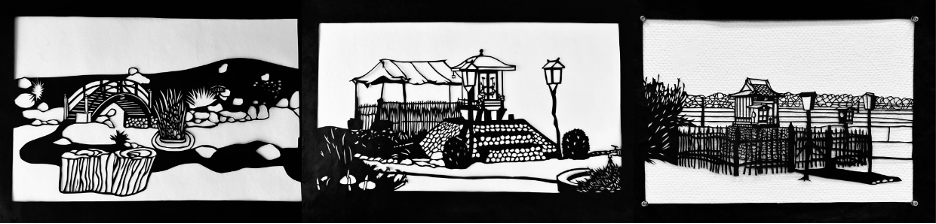
Elysha Rei, Australian internment garden series paper cut study 1 | Australian internment garden series paper cut study 2 | Australian internment garden series paper cut study 3, 2023. Courtesy of the Nikkei National Museum & Cultural Centre.
Elysha Rei’s Australian internment garden series paper cut study offers another way to think about separation and connection contrapuntally. The three hand-cut works on black washi paper depict scenes formed through the careful dispossession of negative space. Each landscape is held together by only the smallest points of overlap where paper stays connected. The internment gardens emerge through what has been cut away, but the image depends on the delicate points that remain.
There is something fitting about this tension within DIS. The exhibition does not need every story to blend into an untouched sheet of washi paper for connections to form between them. Instead, each artwork speaks for itself, while points of contact are created and continually reshaped as visitors move, view, discuss, and discover each story within this shared space of contrapuntal coexistence. Joined not through identicality but plurality, the seven artists within the Legacy Gallery intertwine, sometimes overlap, and remain in dialogue with one another.
The earth is always shifting, the light is always changing, and so too are the points at which these histories touch. And as evening arrives, as the light begins to fade, and the blinds of the Legacy Gallery are drawn once again, perhaps new reflections will emerge in dusk.
Bibliography
Past Wrongs, Future Choices. DIS: displaced, dispersed, dispossessed. Nikkei National Museum & Cultural Centre, 2026. https://centre.nikkeiplace.org/wp-content/uploads/2026/09/DIS-Catalogue-WEB.pdf.
[1] Past Wrongs, Future Choices, DIS: displaced, dispersed, dispossessed (Nikkei National Museum & Cultural Centre, 2026), 7. https://centre.nikkeiplace.org/wp-content/uploads/2026/09/DIS-Catalogue-WEB.pdf.
[2] Past Wrongs, Future Choices, DIS, 7.
[3] Past Wrongs, Future Choices, DIS, 7.
[4] Past Wrongs, Future Choices, DIS, 9.
[5] Past Wrongs, Future Choices, DIS, 9.

 Instagram