A New Home for the New Canadian: Why access to an out-of-print paper mattered to me
Larissa Kondo
People always ask me if I’m “half”. Half what never needs clarification; they aren’t asking if I’m half white. For years, being “half-Japanese” was more of a fun fact than a piece of my cultural identity. Being Japanese felt like one side of a binary. People kept reminding me that, as a monolingual brunette whose family had been here for four generations, I was just “Canadian”.
While attending SFU, I enrolled in a course on the Nikkei experience in North America. Before taking the class, my knowledge of Asian Canadian history had been limited to basic information about the gold rush, construction of the CPR, the Chinese Canadian Head Tax, the Komagata Maru “incident”, and a bit about Japanese Canadian internment. I don’t think I’d ever seen a historical picture of a smiling Asian Canadian. This class was different. Instead of teaching a series of vignettes centred on racism and victimhood, it painted a picture of resilient, determined communities working together to create a more equitable country. I devoured books, papers, and documentaries. I began venturing into Japanese Canadian spaces. At first, I felt I might not be “Japanese enough”, but soon realised I’d seldom be the only mixed-race person in the room. Slowly, I stopped describing myself as “half-Japanese” and began thinking of myself as Japanese Canadian.
This identity-forming process is probably why I connected so strongly with The New Canadian, a Japanese Canadian newspaper that ran from 1938 to 2001. Billing itself as “The Voice of the Second Generation”, it served as a space for young Japanese Canadians to formulate new cultural identities. They were not entirely Japanese, but they also didn’t fit a European vision of what it meant to be Canadian. This cultural formulation was happening at a time when those in power saw all Asian Canadians as distinctly un-Canadian. The New Canadian pushed back against that racist narrative.
Because the paper was written in English and accessible through SFU’s website, I could read it easily. The archives were an incredible historical resource, especially about WWII. During the war, The New Canadian was the only Japanese Canadian publication allowed to continue (they added a Japanese-language section for issei readers).
In the summer of 2024, I had the opportunity to participate in a field school at UVIC that was run in tandem with the Nikkei National Museum’s Tomoshibi bus tour. While there, I heard that SFU’s website would soon stop hosting digitised newspapers owned by the Multicultural History Society of Ontario (MHSO). The New Canadian and 28 other papers, most of which were written by and for other minoritised groups, would only be accessible in-person at the Nikkei National Museum or the MHSO. Access would be significantly limited. This would be a major loss.
When I got home, I emailed the MHSO and SFU, begging them to keep the archives online. It felt somewhat demanding, which made me uncomfortable. Nonetheless, I figured it was worth a try. I forwarded my plea to the list of contacts from the tour and asked them to consider reaching out as well.
Coincidentally, the Powell Street Festival was taking place the next weekend. While setting up, I ran into Heidi Hanazawa, who I’d met on the tour. She suggested I bring a petition to the festival. Begging strangers for signatures seemed daunting, but a festival with tens of thousands of people interested in Japanese Canadian culture seemed like the perfect place for it. I printed a petition and some QR codes that led to email templates. Then, I spent the weekend gathering signatures. The JCCA helped collect signatures at their booth too. Some people suggested an online petition, so I created one after sending off scanned copies of the paper one. A few news outlets reached out, and their coverage helped bring awareness and gather support.
There were times when I wondered if I was being too demanding. Funding is always limited and I’d never worked at a museum or university; who was I to tell them what to prioritise? When those feelings got loud, encouragement from community members and allies reminded me it was a worthwhile cause. I also felt a bit guilty for not advocating specifically for the other papers. I hadn’t felt I had enough time to learn about them, so I decided to keep my focus on The New Canadian. In hindsight, it would have been nice to see if we could have gathered support from other communities whose newspaper archives would also be impacted. In the moment, time felt too scarce.
Ultimately, we were able to get about 5,900 signatures between the paper and online petitions. I’m not sure how many people sent emails but, based on the responses I got from SFU and the MHSO, I infer that many people did. Good news trickled in. SFU would keep the archives up until November. Then, they said they would keep them up until a new host was found. Finally, in April 2026, it was announced that papers had found a new online home: The Internet Archive. The Internet Archive is a massive online repository of text, audio, film, software, and old webpages. You can find everything from old episodes of the Superman radio show to government transcripts. Now, it’s also home to The New Canadian archives. The papers can be downloaded in a variety of formats and are easy to search (click “Search text contents” instead of “Search metadata” if you’re looking for a particular name or phrase).
I am so happy that these important historical resources will remain easily accessible for people around the world. They help paint a fuller portrait of Canada and remind us that Japanese Canadian history is more than just internment. I am incredibly grateful for everyone who helped make this happen, including those who sent emails, signed petitions, arranged agreements, and entered scores of metadata. And, on a personal level, I’m grateful for a historical paper that reminds me that I am part of a larger story.
Larissa Kondo is an elementary school teacher. In her spare time, she enjoys reading, trying to train her cats, and finding ways to use the history degree everyone told her she’d never use. She is fourth-generation Japanese Canadian.
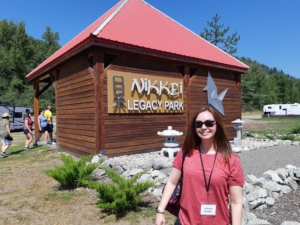
Photo courtesy: Larissa Kondo
 Instagram